
Driver Training
Understanding Road signs and symbols

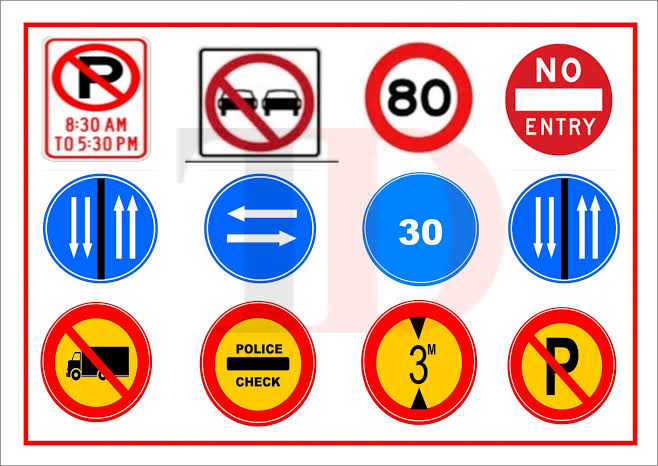
Road signs and symbols are essential for maintaining order and safety on the roads. Here’s an in-depth article about them:
Decoding the language of the road and understanding road signs and symbols are of great advantage to a driver.
As drivers, we encounter a plethora of road signs and symbols on our daily journeys.
These visual cues serve as a universal language, providing valuable information, warnings, and regulations that help us navigate the complex network of roads and highways.
Understanding these signs is not only a legal requirement but also a vital component of responsible and safe driving.
Let’s embark on a journey to decode the meanings and significance of road signs and symbols.
Categorising Road Signs
It can be categorised into three essential types: regulatory signs, warning signs, and informational signs.
1. Regulatory Signs

Regulatory signs are perhaps the most critical of all.
They set forth laws and regulations that must be obeyed, such as speed limits, no-entry zones, yield signs, and stop signs.
Adhering to these signs is imperative for maintaining order and safety on the roads.
2. Warning Signs

Warning signs are intended to alert drivers to potential hazards or changes in road conditions ahead.
These include signs for sharp curves, pedestrian crossings, slippery roads, and animal crossings.
Being attentive to warning signs is crucial for anticipating and responding to potential dangers.
3. Informational Signs

Informational signs provide, as the name suggests, information about services, facilities, and points of interest.
These encompass signs indicating rest areas, hospitals, petrol stations, and tourist attractions.
Being aware of these signs can help in planning pit stops and navigating unfamiliar areas.
Understanding Road Markings
In addition to signs, road markings also play a pivotal role in guiding drivers.
Lane markings, pedestrian crossings, stop lines, and directional arrows all contribute to the safe and efficient flow of traffic.
International Standards and Variations
While many road signs are standardized across different regions and countries, there are some variations.
For instance, the colours and shapes of signs may vary, and certain symbols may hold different meanings in different places.
Familiarizing oneself with the specific signage of the area one is driving in is essential for safe and legal driving.
Test Your Knowledge
To ensure proficiency in understanding road signs and symbols, one can utilize quizzes and educational resources to cement their knowledge.
Many government transportation departments offer online resources and study guides to aid in this process.
Staying Updated and Vigilant
Finally, it’s crucial to stay updated on any changes in road signage and symbols.
New regulations, signage, and infrastructure developments may impact driving conditions and require adaptation.
In conclusion, road signs and symbols are the silent guardians of our journeys, imparting wisdom and guidance without uttering a word.
Mastering their language ensures not only legal compliance but, more importantly, the safety and well-being of all who travel the roads.
So, the next time you’re behind the wheel, take a moment to appreciate the silent eloquence of these signs and symbols, and may your journeys always be informed and secure.
I hope this article sheds light on the significance of road signs and symbols. Safe travels, and may you always find clarity and guidance on the road ahead.




Five Die as Truck, Car Collide on Badagry Expressway

Two Killed as Trucks Collide, Burst Into Flames on Anambra Road

Stakeholders Raise Alarm Over Safety Gaps in Nigeria’s CNG and Electric Vehicle Transition

Female Driver Dies in Tragic Road Crash at Mongoro, Ile-Zik Area of Lagos

Physically Challenged Beggar Killed in Multi-Vehicle Crash on Lagos-Ibadan Expressway

Court Bars FRSC Officials From State Roads

24 Pupils Killed in Tragic Bus Crash During School Excursion in Uganda

Tyre Blowouts on Heavy Trucks

BYD Seal EV: Can It Challenge Traditional Sedans?

Colorado to Strengthen Driver Education Requirements

Slow Down: Man got his Family Killed by neglecting road signs

Which Bridge is the Tallest in the World?
Impatient Driving Cause Road Accident
How Roads are Constructed on the Mountain

Texas, USA suffers heavy flooding