
Articles
BMW vs. Mercedes-Benz: Honest Comparison


When it comes to luxury automobiles, BMW and Mercedes-Benz stand out as two of the most prestigious and sought-after brands in the industry.
Both German automakers have a rich history of innovation, engineering excellence, and performance. However, choosing between them can be challenging, as each offers unique strengths in design, technology, driving experience, and overall value.
This article provides a comprehensive comparison of BMW vs. Mercedes-Benz, analyzing key aspects such as performance, reliability, interior quality, technology, pricing, and brand prestige.
 1. Performance and Driving Experience
 1. Performance and Driving Experience
BMW: The Ultimate Driving Machine
BMW has long marketed itself as the “Ultimate Driving Machine,” focusing on sporty handling and driver engagement. BMW vehicles are known for:
- Precise Steering: BMWs typically have a sharper, more responsive steering feel.
- Rear-Wheel Drive Focus: Many BMW models come with a rear-wheel-drive (RWD) setup, contributing to a dynamic driving experience.
- Sporty Suspension: BMW’s suspension tuning prioritizes agility and road feedback, making it a favorite among driving enthusiasts.
- M Series Performance Models: BMW’s M Division produces high-performance models like the M3, M5, and M8, which deliver track-ready performance.
Mercedes-Benz: Luxury and Smoothness
Mercedes-Benz, on the other hand, focuses more on comfort and refinement, offering:
- Smoother Ride Quality: Mercedes-Benz vehicles feature softer suspension setups for a more comfortable ride.
- All-Wheel Drive Options: Many Mercedes models come with 4MATIC AWD, providing excellent traction and stability.
- AMG Performance Line: The AMG division produces high-performance versions like the AMG C63 and AMG GT, which combine power with luxury.
- Advanced Driving Aids: Mercedes offers advanced driver-assistance systems for a more relaxed driving experience.
Verdict:
If you prioritize a sporty and engaging driving experience, BMW is the better choice.
If you prefer luxury and smoothness, Mercedes-Benz is the way to go.
2. Interior and Comfort
BMW: Sporty and Driver-Oriented
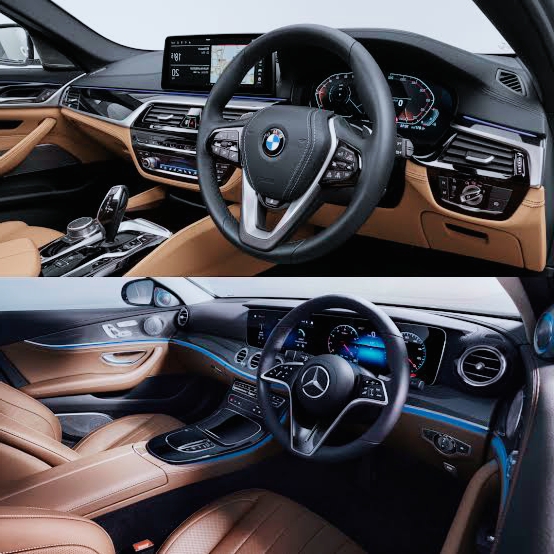
- BMW interiors have a driver-focused cockpit with an ergonomic layout.
- The materials are high-quality, but some entry-level models have simpler designs compared to Mercedes.
- BMW’s iDrive infotainment system is intuitive and well-integrated.
Mercedes-Benz: Elegance and Luxury
- Mercedes interiors emphasize elegance and sophistication, with premium materials and ambient lighting.
- Higher-end models feature Burmester sound systems, Nappa leather, and wood trim.
- The MBUX infotainment system is one of the most advanced, with AI-based voice commands and high-resolution displays.
Verdict:
BMW offers a more functional, sporty interior, while Mercedes focuses on luxury and comfort.
3. Technology and Infotainment
Both brands are at the forefront of automotive technology, but they have different approaches.
BMW Technology
- iDrive System: One of the most refined infotainment systems with a rotary dial, touchscreen, and voice control.
- Live Cockpit Professional: Digital instrument clusters with a focus on driver engagement.
- Driving Assistance: Features like adaptive cruise control, lane-keeping assist, and gesture controls.
Mercedes-Benz Technology
- MBUX Infotainment: AI-based voice control system (“Hey Mercedes”).
- Hyperscreen (on EQ models): A massive, high-resolution touchscreen spanning the dashboard.
- Safety Features: Pre-Safe, automatic braking, and semi-autonomous driving technology.
Verdict:
BMW’s technology is driver-focused, while Mercedes-Benz offers a more futuristic and luxurious experience.
4. Reliability and Maintenance Costs
BMW Reliability
- BMWs are known for advanced engineering, but they can be expensive to maintain.
- Common issues include electronic malfunctions and turbocharger problems in some models.
- Maintenance costs are generally higher than average due to specialized parts.
Mercedes-Benz Reliability
- Mercedes-Benz vehicles are slightly more reliable than BMWs, but maintenance costs are still high.
- Some models, especially AMG variants, have complex engines that require specialized servicing.
- Mercedes offers longer service intervals, reducing frequent maintenance needs.
Verdict:
Mercedes-Benz has a slight edge in reliability, but both brands have high maintenance costs compared to non-luxury vehicles.
5. Pricing and Value
BMW Pricing
- Entry-Level Models: BMW 3 Series starts around $45,000.
- Mid-Range Models: BMW X5 SUV starts at $66,000.
- Luxury Models: BMW 7 Series starts at $97,000.
- High-Performance Models: BMW M5 starts at $110,000.
Mercedes-Benz Pricing
- Entry-Level Models: Mercedes C-Class starts around $47,000.
- Mid-Range Models: Mercedes GLE SUV starts at $62,000.
- Luxury Models: Mercedes S-Class starts at $115,000.
- High-Performance Models: AMG GT starts at $140,000.
Verdict:
BMWs are slightly more affordable at the entry level, while Mercedes-Benz vehicles tend to be pricier, especially in the luxury segment.
6. Brand Prestige and Resale Value
BMW Brand Perception:
- Appeals to younger, performance-oriented drivers.
- Seen as the brand for those who love driving.
- Better resale value for performance models like the M3 and M5.
Mercedes-Benz Brand Perception:
- Appeals to luxury-focused buyers who prioritize comfort and elegance.
- Often associated with executives and high-net-worth individuals.
- Higher resale value for flagship models like the S-Class and G-Wagon.
Verdict:
BMW appeals to sportier drivers, while Mercedes-Benz is preferred by those who value status and luxury.
Which One is Right for You?
Final Thoughts:
Choose BMW if you love performance, handling, and a driver-focused experience.
Choose Mercedes-Benz if you prefer luxury, comfort, and advanced technology.
Ultimately, the choice depends on your personal preferences, budget, and driving needs. Both BMW and Mercedes-Benz offer world-class vehicles, ensuring that no matter your choice, you’ll be driving a top-tier luxury car.

Five Die as Truck, Car Collide on Badagry Expressway

Two Killed as Trucks Collide, Burst Into Flames on Anambra Road

Stakeholders Raise Alarm Over Safety Gaps in Nigeria’s CNG and Electric Vehicle Transition

Female Driver Dies in Tragic Road Crash at Mongoro, Ile-Zik Area of Lagos

Physically Challenged Beggar Killed in Multi-Vehicle Crash on Lagos-Ibadan Expressway

Court Bars FRSC Officials From State Roads

24 Pupils Killed in Tragic Bus Crash During School Excursion in Uganda

Tyre Blowouts on Heavy Trucks

BYD Seal EV: Can It Challenge Traditional Sedans?

Colorado to Strengthen Driver Education Requirements

Slow Down: Man got his Family Killed by neglecting road signs

Which Bridge is the Tallest in the World?
Impatient Driving Cause Road Accident
How Roads are Constructed on the Mountain

Texas, USA suffers heavy flooding