
Road Safety / Heavy Vehicle Awareness
Japan Tests Holographic Crossing Guards to Protect Children

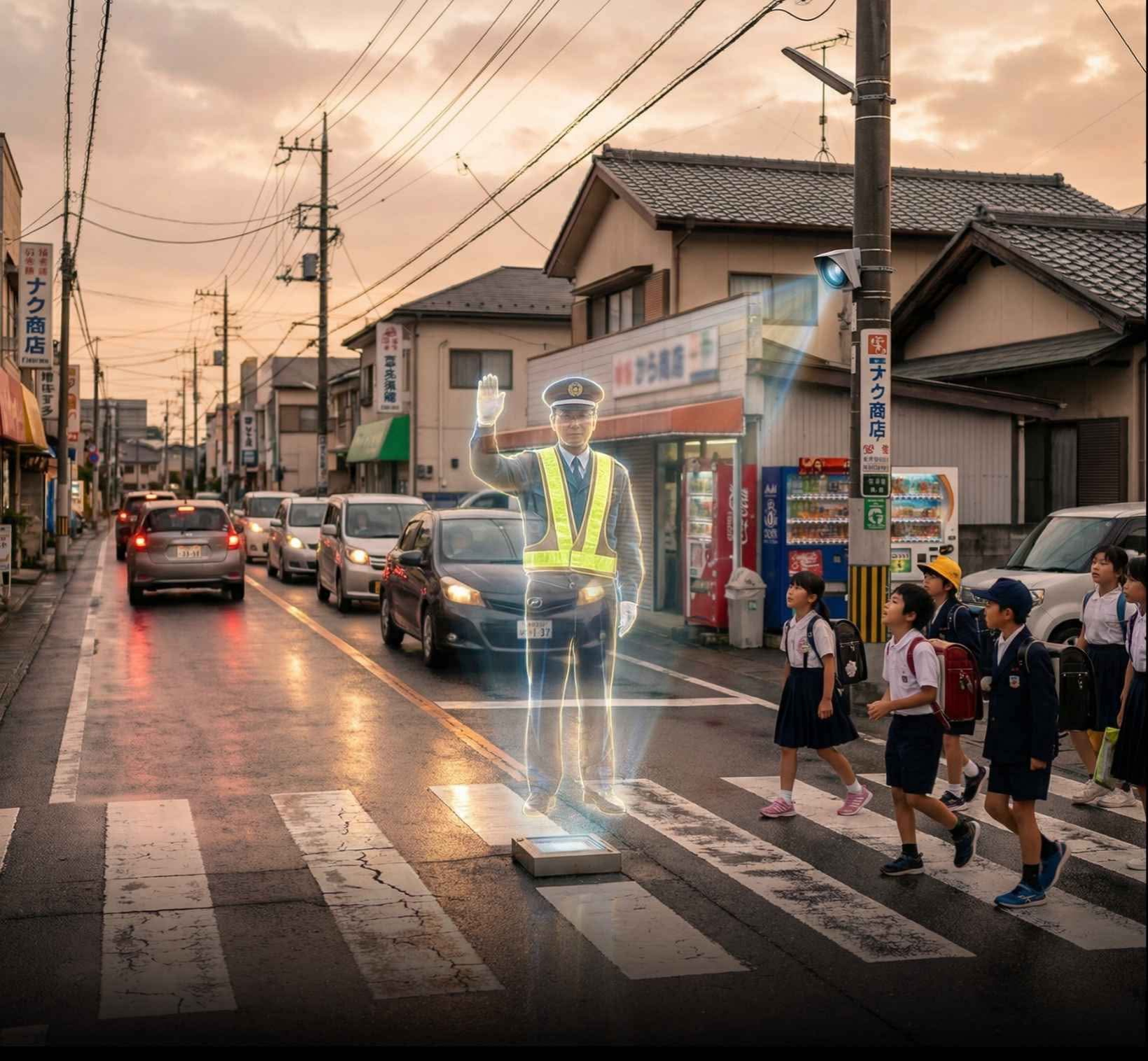
Engineers in Japan are testing an innovative approach to road safety that could change how children cross busy streets.
Also Read:
- Brand New Japanese Cars Arrive in Russia Frozen Solid After Brutal Winter
- Delhi Road Safety Experts Advocate 30 km/h Limits in High-Risk Zones
The concept involves holographic crossing guards projected, human-shaped light figures that appear at crosswalks when pedestrians are about to cross, especially near schools.
Instead of relying only on painted zebra crossings and static road signs, the new system uses projected light and smart sensors to create highly visible, interactive crossings that command drivers’ attention and encourage them to slow down.
The technology is part of Japan’s broader effort to blend smart infrastructure with everyday public safety.
How the Holographic Crossing Guard Works
The system is designed to activate only when someone is waiting to cross the road.
Sensors installed near the curb detect movement and trigger a projection unit that displays a bright, glowing human figure on or beside the crosswalk.
Key features include:
- A life-sized, illuminated human-shaped figure that resembles a traditional crossing guard
- Bright colors and flashing light effects to attract driver attention
- Optional illuminated pathways on the road surface marking the pedestrian crossing zone
- Automatic shutdown when no pedestrians are present
The projected figure often stands in a “stop” or “hold” posture, visually signaling drivers to slow down and prepare to stop.
Why This Matters for Child Safety
Children are among the most vulnerable road users, particularly during morning school runs and afternoon dismissal periods.
Young pedestrians can be harder to see, may misjudge vehicle speed, and often lack the experience to react quickly in complex traffic situations.
By adding a dynamic, highly visible visual cue, engineers hope to:
- Reduce the risk of drivers missing crosswalks
- Improve reaction time for approaching vehicles
- Encourage safer driving behavior in school zones
- Make children feel more confident when crossing
The system essentially gives children an extra layer of protection without requiring them to carry devices or interact with complicated technology.
Advantages Over Traditional Road Signs
Unlike physical traffic signs or permanent crossing lights, holographic crossing guards offer several practical benefits:
1. Minimal Road Construction
The technology can be installed without digging up roads or adding large structures, reducing installation cost and disruption.
2. Energy Efficiency
Because the system only activates when pedestrians are present, it consumes less power than lights that run continuously.
3. Reduced Visual Clutter
When inactive, the projections disappear, keeping streets visually clean and less congested with signage.
4. Adaptability
Brightness levels and colors can be adjusted based on weather, time of day, and traffic conditions.
Smart Cities and the Future of Crosswalks
Japan has long been a global leader in applying technology to public infrastructure.
From intelligent traffic signals to advanced driver-assistance systems, the country continues to explore ways to reduce crashes through innovation.
Holographic crossing guards represent a shift toward interactive road environments, where streets respond in real time to human presence rather than remaining static.
Future versions of the system could integrate with:
- Traffic signal networks
- Speed-monitoring cameras
- Vehicle-to-infrastructure (V2I) communication systems
- Emergency response alerts
Such integration could create safer, more responsive urban road networks.
Implications for Other Countries
If proven effective, this technology could be adopted worldwide, especially in cities struggling with high pedestrian injury rates.
For countries with dense urban populations and heavy traffic, smart crosswalk solutions could:
- Reduce pedestrian fatalities
- Improve driver compliance in school zones
- Lower enforcement costs
- Enhance public confidence in road safety systems
Developing nations may also benefit from simplified versions of the technology that focus on affordability and durability.
RoadKing Perspective
Innovations like holographic crossing guards show that road safety is no longer just about asphalt and paint.
Technology is becoming a central tool in protecting lives, particularly the lives of children.
As cities explore smarter infrastructure, the focus must remain on solutions that are:
- Practical
- Affordable
- Scalable
- Proven to reduce crashes
Every step toward safer crossings is a step toward safer communities.







Five Die as Truck, Car Collide on Badagry Expressway

Two Killed as Trucks Collide, Burst Into Flames on Anambra Road

Stakeholders Raise Alarm Over Safety Gaps in Nigeria’s CNG and Electric Vehicle Transition

Female Driver Dies in Tragic Road Crash at Mongoro, Ile-Zik Area of Lagos

Physically Challenged Beggar Killed in Multi-Vehicle Crash on Lagos-Ibadan Expressway

Court Bars FRSC Officials From State Roads

24 Pupils Killed in Tragic Bus Crash During School Excursion in Uganda

Tyre Blowouts on Heavy Trucks

BYD Seal EV: Can It Challenge Traditional Sedans?

Colorado to Strengthen Driver Education Requirements

Slow Down: Man got his Family Killed by neglecting road signs

Which Bridge is the Tallest in the World?
Impatient Driving Cause Road Accident
How Roads are Constructed on the Mountain

Texas, USA suffers heavy flooding