
Crash News
Six Dead, Fourteen Injured in Ebonyi Highway Crash: Reckless Overtaking Blamed

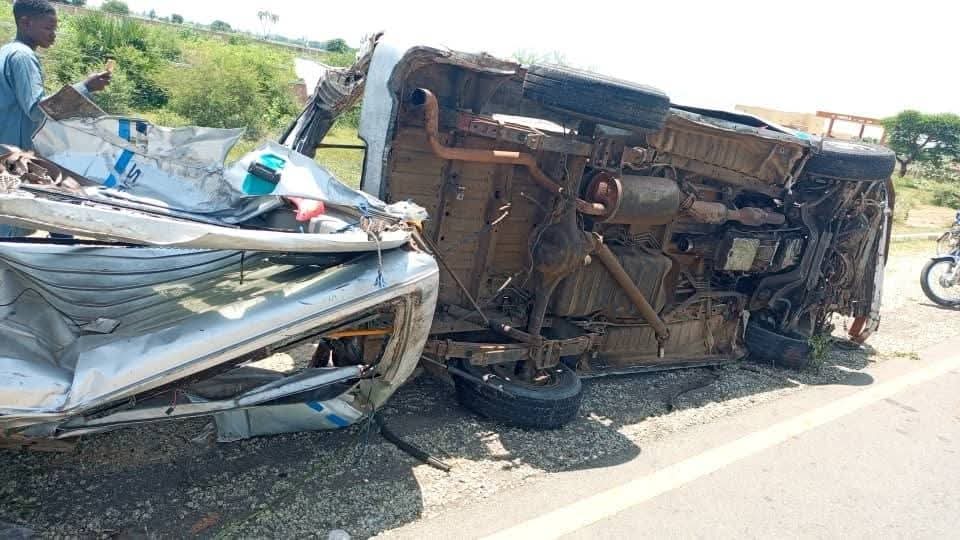
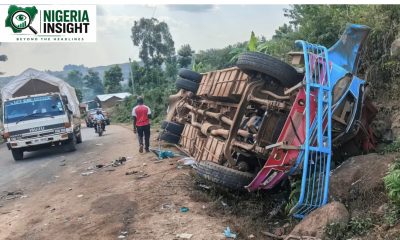
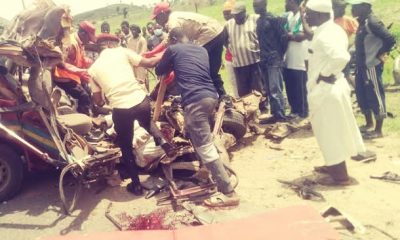
A dark cloud fell over Ebonyi State on the evening of October 17, 2025, when a fatal road crash along the Enugu–Abakaliki Federal Highway near the Nkalagu flyover claimed six lives and left fourteen others injured.
Also Read: Why Do So Many Car Accidents Happen at Night?
The tragic collision between a Toyota Hiace commercial bus and an articulated truck has once again brought to national attention Nigeria’s worsening crisis of reckless driving, dangerous overtaking, and systemic neglect of highway safety enforcement.
According to initial reports from the Federal Road Safety Corps (FRSC) and eyewitnesses, the crash occurred around 6:45 p.m., at a sharp bend notorious for accidents, where poor visibility and overspeeding have combined to create a deadly cocktail of danger for years.
The commercial bus, reportedly en route from Abakaliki to Enugu, attempted to overtake a slow-moving truck on a narrow stretch of the road when it lost balance and collided head-on with the oncoming articulated vehicle.
Eyewitness Accounts: “We Saw Death in Front of Us”
For survivors, the incident felt like a nightmare that unfolded in seconds.
Mr. Chigozie Nworie, a trader who was among the first responders, described the scene as “pure horror.”
“The bus was speeding too much. The driver tried to overtake a trailer carrying cement, but before he could return to his lane, another truck was coming from the opposite side. The collision was so loud people ran from nearby houses. We saw death in front of us,” he recounted to RoadKing.ng.
Among the victims were three men and three women, all of whom died instantly from the impact. FRSC officials at the scene confirmed that at least 22 persons were involved in the accident, 12 males and 10 females, many of them traders returning from a local market.
Several of the injured were rushed to Annunciation Hospital in Enugu and the National Orthopaedic Hospital, while others received treatment at nearby private clinics due to the overwhelming number of casualties.
Reckless Overtaking: The Silent Killer on Nigerian Highways
The FRSC Sector Commander in Ebonyi State, Corps Commander Anthony Okorie, described the crash as “avoidable and tragic.” He blamed it squarely on dangerous overtaking — one of the leading causes of fatal accidents in Nigeria.
“Drivers must learn patience. Dangerous overtaking remains one of the top three killers on our roads. This accident at Nkalagu was not an act of fate; it was caused by human impatience,” Okorie lamented.
Statistics from the National Bureau of Statistics (NBS) reveal that reckless overtaking contributes to over 15% of all fatal road crashes in Nigeria annually, ranking just behind speeding and mechanical failure. Yet, enforcement remains weak, with many commercial drivers disregarding road rules, emboldened by poor policing and lax penalties.
The Enugu–Abakaliki corridor has long been a red flag for traffic authorities. Despite its designation as a federal highway, sections of the road remain poorly maintained, with faded lane markings, sharp curves, and inadequate signage, all of which encourage confusion and risk-taking among motorists.
FRSC’s Response: Urgent Call for Discipline Behind the Wheel
In a press release on October 18, the FRSC reiterated its appeal for restraint among drivers, particularly commercial operators who ply the interstate corridors daily. The agency announced plans to intensify highway patrols across Ebonyi and Enugu States, deploying new mobile speed detection devices to monitor overspeeding in real-time.
The statement also noted that the remains of the deceased had been deposited at St. Vincent Morgue, while investigations into the cause of the crash were ongoing.
However, road safety advocates argue that reactive enforcement alone cannot solve a structural problem.
Mr. Frank Nnaji, founder of the Coal City Drivers’ Union, told RoadKing.ng that many of Nigeria’s commercial drivers lack proper certification and professional training.
“Most of these drivers never went through any driving school. They learn by trial and error. Some even drive under the influence of alcohol or drugs. We need a reform of the entire licensing system, not just arrests after accidents,” he said.
Families in Mourning: “Our Breadwinner Is Gone”
At Presco Junction, Abakaliki, the family of Mrs. Loveth Igwe, one of the victims, was inconsolable. Her husband, Mr. Emmanuel Igwe, told RoadKing.ng that she had boarded the bus to attend a church convention in Enugu and had promised to return the next morning.
“She called me before leaving Abakaliki and said she would be back on Saturday. That was the last time I heard her voice. They told me she died on the spot. How can I tell my children?” he said, his voice breaking.
In a nearby compound, Mrs. Grace Ude, mother of another victim, said her 27-year-old son had just started a new job as a mechanic apprentice in Enugu.
“He was full of hope. He even said this job would change our life. Now look at what impatience has done,” she said.
The six victims were buried in their respective hometowns after brief family ceremonies, with local pastors calling for repentance and discipline among motorists.
The Broader Picture: Ebonyi’s Troubled Highway Network
Ebonyi State has been struggling with a high rate of road crashes in recent years. Data from the FRSC Zone 9 Command (Enugu) show that between January and September 2025 alone, the state recorded 178 accidents, with 64 fatalities, a 12% increase from the same period in 2024.
Experts attribute this to a combination of poor road conditions, unregulated vehicle imports, and driver fatigue from long working hours.
The Nkalagu–Abakaliki–Enugu corridor, despite being one of the busiest trade routes in southeastern Nigeria, remains a notorious death zone.
Dr. Ifeanyi Mbah, a transportation analyst and lecturer at Ebonyi State University, told RoadKing.ng that Nigeria’s failure to design driver-centric roads contributes to these tragedies.
“Our roads are built for cars, not for people. We neglect proper signage, lighting, and speed-calming infrastructure. As long as we build highways that reward speed rather than discipline, we will continue to bury our citizens,” he explained.
Voices from the Road: Commercial Drivers React
At the Abakaliki Motor Park, tension was high as drivers discussed the latest tragedy.
Mr. Sunday Opara, a 42-year-old driver with over two decades of experience, blamed what he called the “rush culture” among young drivers.
“Most of these new drivers behave like they’re in a race. They drive like Formula 1 stars on a federal road. We older drivers are suffering because their recklessness gives everyone a bad name,” he said.
Another driver, Ali Musa, emphasized the need for FRSC to collaborate with transport unions to conduct regular awareness campaigns.
“Instead of waiting until people die, FRSC should enter our parks every month and talk to drivers. Let them teach us the real dangers of speed,” Musa added.
Government Reaction: Ebonyi Promises Road Rehabilitation
Following the public outcry, the Ebonyi State Government announced plans to begin emergency maintenance of accident-prone portions of the Enugu–Abakaliki Road.
Commissioner for Works, Chief Uchenna Eze, stated that while the highway is federally owned, the state cannot continue to watch lives lost needlessly.
“We will fill dangerous potholes, repaint lanes, and mount reflective signs at bends. We are also working with the FRSC to set up a mini rescue post near Nkalagu,” Eze said.
However, civil society groups criticized the government for its “reactionary approach,” arguing that repeated promises after every tragedy have done little to stop the carnage.
Call for Legislative Action
In the National Assembly, Senator Obinna Ogba (Ebonyi Central) has called for a motion urging the Federal Ministry of Works to expedite rehabilitation of all failing sections of federal highways in the Southeast. He also proposed stiffer penalties for reckless driving, including mandatory six-month suspension of licenses for drivers convicted of dangerous overtaking.
“Until we criminalize this kind of recklessness, Nigerians will continue to die on highways that are meant to connect communities, not destroy them,” he told reporters.
RoadKing Analysis: When Impatience Becomes National Tragedy
This Ebonyi incident is not an isolated event; it is part of a broader epidemic. In the last six months alone, Nigeria has witnessed a disturbing rise in fatal crashes attributed to overtaking and speeding from Ogun’s fiery tanker explosions to Yobe’s overspeeding carnage.
The pattern is clear: impatience, poor enforcement, and infrastructural neglect continue to turn highways into death corridors.
At RoadKing.ng, we have consistently highlighted that solving Nigeria’s road safety crisis requires a three-tier strategy:
- Driver Reform – Mandatory retraining and psychological evaluation for commercial drivers every two years.
- Engineering Solutions – Reconstruction of roads with proper lane markings, speed breakers, and reflective warnings at sharp bends.
- Institutional Accountability – Empowering FRSC to enforce road discipline without political interference or bribery.
Until these steps are fully implemented, tragedies like the Nkalagu crash will remain an all-too-familiar headline.



Five Die as Truck, Car Collide on Badagry Expressway

Two Killed as Trucks Collide, Burst Into Flames on Anambra Road

Stakeholders Raise Alarm Over Safety Gaps in Nigeria’s CNG and Electric Vehicle Transition

Female Driver Dies in Tragic Road Crash at Mongoro, Ile-Zik Area of Lagos

Physically Challenged Beggar Killed in Multi-Vehicle Crash on Lagos-Ibadan Expressway

Court Bars FRSC Officials From State Roads

24 Pupils Killed in Tragic Bus Crash During School Excursion in Uganda

Tyre Blowouts on Heavy Trucks

BYD Seal EV: Can It Challenge Traditional Sedans?

