
Crash News
Players Injured as Team Bus Loses Control on Nigerian Road

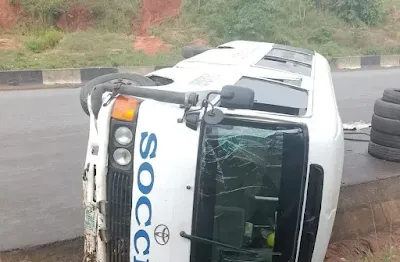
A routine journey to honor a football fixture turned into a nightmare after a Nigerian club, Rovers FC, was involved in a devastating highway crash that left several players injured and at least one fighting for his life.
The incident, which occurred on a major inter-state road while the team traveled toward Lagos, has once again exposed the dangerous reality of road travel in Nigeria, especially for organized groups like sports teams.
According to initial reports, the team bus conveying players and officials suddenly lost control while moving at speed, veering off the highway before tumbling.
Witnesses described a chaotic scene:
- The bus reportedly swerved uncontrollably
- It overturned after leaving its lane
- Passersby rushed to rescue trapped occupants
Although the exact cause is yet to be confirmed, early indications point to a combination of:
- Mechanical failure (possible brake issues)
- Poor road surface conditions
- Driver fatigue from long-distance travel
- Possible speeding
Authorities are currently investigating to determine the precise trigger.
The crash left multiple players and team officials injured, with varying degrees of severity:
- Several victims suffered fractures, cuts, and internal injuries
- At least one player remains in critical condition
- Emergency responders arrived swiftly, evacuating victims to nearby hospitals
Eyewitnesses credited local residents and first responders for acting quickly, which likely prevented fatalities from rising further.
The management of Rovers FC released a statement describing the incident as:
“A painful and distressing moment for the club, our players, and supporters.”
The accident has triggered widespread reactions:
- Fellow clubs sending solidarity messages
- Fans expressing concern on social media
- Calls for improved welfare and safety for players
For many, this is more than just an accident, it is a wake-up call.
This incident highlights a systemic issue: most Nigerian football teams rely heavily on road transport.
Why teams travel by road:
- High cost of domestic flights
- Limited sponsorship and funding
- Tight match schedules across distant locations
Risks involved:
- Long hours behind the wheel
- Poorly maintained highways
- Aging or poorly serviced buses
- Driver exhaustion
Unlike elite teams with better logistics, many clubs operate under financial constraints, forcing them to compromise on safety.
Nigeria continues to record alarming road accident figures.
According to the Federal Road Safety Corps (FRSC):
- Thousands of crashes occur annually across major highways
- Human factors (speeding, fatigue, reckless driving) account for the majority
- Commercial and passenger buses are among the most affected
Group travel vehicles, such as team buses, carry higher risks due to:
- High passenger volume
- Limited seatbelt compliance
- Increased impact during rollovers
Many Nigerian highways remain accident-prone due to:
- Potholes and uneven surfaces
- Ongoing construction zones
- Poor signage and lighting
- Narrow or collapsing shoulders
For long-distance travelers like football teams, these roads become unpredictable danger zones, especially at high speeds.
While road conditions contribute, driver behavior remains the leading cause of accidents.
Common risk factors include:
- Fatigue after long hours of driving
- Speeding to meet match schedules
- Distraction or reduced alertness
- Poor decision-making under pressure
Fatigue, in particular, is dangerous because it:
- Slows reaction time
- Causes momentary sleep (microsleep)
- Impairs judgment
This accident raises urgent questions:
- Should football teams continue to rely solely on road transport?
- Are clubs doing enough to protect their players?
- Should regulators step in to enforce safety standards?
Stakeholders, including sports authorities, government agencies, and club owners must act before another tragedy occurs.






Five Die as Truck, Car Collide on Badagry Expressway

Two Killed as Trucks Collide, Burst Into Flames on Anambra Road

Stakeholders Raise Alarm Over Safety Gaps in Nigeria’s CNG and Electric Vehicle Transition

Female Driver Dies in Tragic Road Crash at Mongoro, Ile-Zik Area of Lagos

Physically Challenged Beggar Killed in Multi-Vehicle Crash on Lagos-Ibadan Expressway

Court Bars FRSC Officials From State Roads

24 Pupils Killed in Tragic Bus Crash During School Excursion in Uganda

Tyre Blowouts on Heavy Trucks

BYD Seal EV: Can It Challenge Traditional Sedans?

Colorado to Strengthen Driver Education Requirements

Slow Down: Man got his Family Killed by neglecting road signs

Which Bridge is the Tallest in the World?
Impatient Driving Cause Road Accident
How Roads are Constructed on the Mountain

Texas, USA suffers heavy flooding