
News Update
Breaking: Tricycle Rider Killed in Ekoro Junction Crash


It was meant to be a regular Tuesday morning in Lagos, bustling, noisy, and impatient as usual. But by 8:15 a.m. on November 5, 2025, the routine chaos at Ekoro Junction, located in Lagos’ Abule Egba axis, turned deadly.
Also Read: How Impatience and Indiscipline Are Killing More Motorists Than Bad Roads
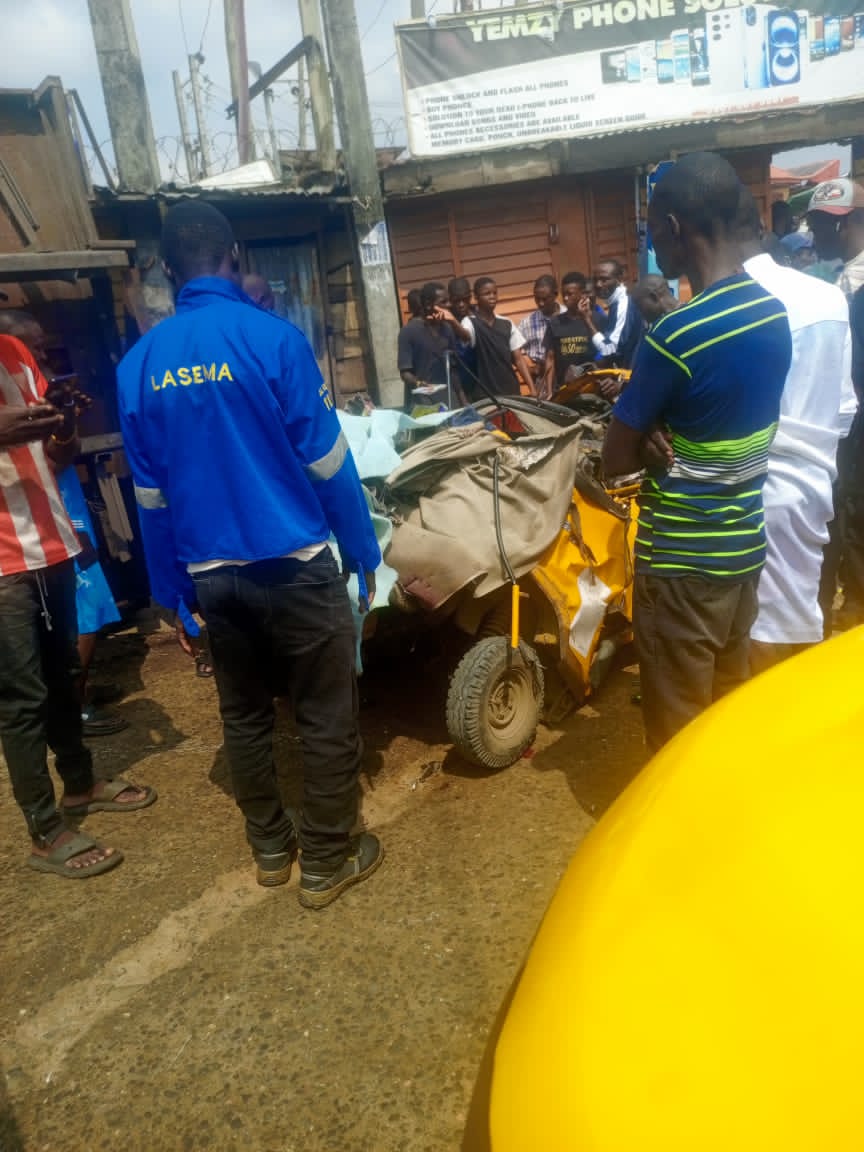
A commercial tricycle, popularly known as Keke Napep, collided with an oncoming vehicle while navigating a tight corner near the busy intersection. The impact flung the tricycle sideways, crushing its driver against the asphalt.
By the time help arrived, the rider was gone, leaving two passengers bleeding, disoriented, and screaming for help.
According to eyewitnesses and reports from FRSC Lagos Sector Command, the deceased, believed to be in his late 20s was attempting to cross the junction when a speeding private car rammed into his tricycle from behind.
The tragedy highlights an uncomfortable truth: Lagos’ intersections have become ticking time bombs, chaotic spaces where recklessness, poor road design, and weak enforcement intersect daily.
By mid-morning, a small crowd had gathered at the scene. Traders, bus conductors, and commuters stood in silence as traffic officials cordoned off the site. The tricycle lay mangled beside a drainage culvert, its yellow body crushed like tin foil.
Nearby, blood stains painted the pavement. A pair of brown sandals, believed to belong to the victim, lay in the middle of the lane.
FRSC personnel swiftly cleared the debris, while officers from Ilewe Police Station took custody of the victim’s remains.
“We heard a loud bang and ran out,” said Mrs. Bisi Olumide, a food vendor near the junction.
“The car was trying to beat the traffic light, and the Keke was turning. The poor boy didn’t even see it coming.”
Another eyewitness, Mr. Aliyu Danladi, said the tricycle flipped twice before landing.
“The passengers shouted for help, but by the time we reached, the driver wasn’t moving. His steering was stuck in his chest.”
The deceased, identified by other riders as Chinedu Eze, hailed from Enugu State and had been driving the same Keke for nearly three years. Friends described him as quiet, hardworking, and determined to save money to buy his own vehicle.
“He never drank or smoked,” said Ifeanyi Nwosu, a fellow rider from the nearby Ekoro Park.
“He used to say, ‘This Keke is my life.’ But Lagos traffic doesn’t forgive anyone.”
Chinedu left behind a wife and a one-year-old daughter.
Ekoro Junction sits along one of the busiest arteries in Lagos’ mainland, a crossroads feeding traffic between Abule Egba, Ijaiye, and Iyana Ipaja.
Every day, an estimated 45,000 vehicles, including buses, motorcycles, tricycles, and tankers, pass through the area. Yet, the intersection is barely regulated by functional traffic lights.
During peak hours, motorists often rely on informal signals from LASTMA officers or impatient hand gestures from fellow drivers. The result is organized chaos, until it isn’t.
RoadKing Analysis: The Deadly Anatomy of a Junction Crash
Through field assessment and expert interviews, RoadKing.ng identified five recurring risk factors that make intersections like Ekoro Junction death traps.
1️⃣ Overcrowding and Indiscipline
Tricycles, buses, and motorbikes all compete for narrow lanes. Impatience drives riders to swerve dangerously, often squeezing between moving vehicles.
2️⃣ Speeding at Approach
Instead of slowing down when nearing a junction, many drivers accelerate to “beat” others. This habit increases kinetic force on impact, turning minor collisions into fatal ones.
3️⃣ Non-functional Traffic Lights
Several lights around the Abule Egba–Ekoro corridor are either broken or ignored. Without clear signals, drivers rely on guesswork and aggression.
4️⃣ Poor Visibility
Streetlights are inadequate, and signage is either faded or vandalized. At night, junctions become blind spots.
5️⃣ Weak Law Enforcement
LASTMA presence is sporadic. Drivers exploit the gap, knowing enforcement officers can’t monitor every intersection at once.
Tricycles, or Keke Napep, were introduced in the early 2000s as a low-cost transport solution. But their design open sides, lightweight frame, and minimal crash protection makes them extremely dangerous during collisions.
“A Keke offers almost zero safety barrier,” explained Engr. Samuel Adetunji, a vehicle safety expert.
“Even at 40 km/h, an impact can eject riders or crush them because there’s no structural frame like a car’s cabin.”
According to FRSC Q3 2025 data, tricycles account for 11% of all recorded traffic fatalities in Lagos State, up from 7% in 2022. The majority occur at intersections and highway merges.
At the nearby Ekoro Motor Park, tricycle riders gathered in small groups, visibly shaken.
“Every week, somebody dies on this road,” said Kehinde Abubakar, another Keke operator. “Drivers of cars don’t respect us. We are humans too.”
“The government banned Okada, but left Keke without protection or training,” added Emeka Ofor, a union representative. “We need dedicated lanes and proper helmets — not just blame.”
Several complained that speed bumps and reflective lines have worn out, making it impossible to see lane boundaries at night.
FRSC Data Snapshot: Intersection Crashes on the Rise
| Year | Reported Intersection Crashes (Lagos) | Fatalities | Major Injury Cases |
|---|---|---|---|
| 2022 | 418 | 72 | 211 |
| 2023 | 509 | 94 | 260 |
| 2024 | 612 | 117 | 298 |
| 2025 (Jan–Sept) | 471 | 89 | 254 |
Source: FRSC Lagos Command, 2025 Quarterly Crash Report.
Why Intersection Safety Matters
Traffic engineers describe junctions as “conflict points”, locations where multiple streams of traffic intersect, increasing collision probability.
A typical four-way junction can have up to 32 potential vehicle conflict paths, far more than any other part of the road network.
In Lagos, where road user discipline is low, every junction becomes a potential battlefield.
RoadKing Technical Breakdown: What Happens During a Junction Impact
When two vehicles collide at an intersection, the energy transfer is instantaneous.
For tricycles:
- There’s no crumple zone to absorb shock.
- The rider’s body takes the direct impact.
- In side impacts, passengers are thrown outward.
Average survival speed for tricycle collisions = below 30 km/h. Anything higher leads to severe injury or death.
Policy Gaps and Government Responsibility
Despite dozens of crashes, intersection redesign remains slow.
RoadKing’s investigation found that the Ekoro–Abule Egba corridor has only one operational traffic signal across a 3-km stretch.
Pedestrian crossings are faded, and signages are obsolete.
The Lagos State Ministry of Transportation allocated ₦2.1 billion for “smart traffic lights” in its 2024 budget but less than 40% have been deployed.
Experts say until infrastructure matches traffic density, intersection deaths will keep rising.
RoadKing’s Safety Recommendations
1️⃣ Redesign High-Risk Junctions
Install roundabouts or raised intersection platforms to slow vehicles automatically.
2️⃣ Smart Traffic Signalization
Deploy solar-powered lights with automatic sensors that adapt to flow — reducing red-light running.
3️⃣ Dedicated Keke Lanes
Create narrow, marked lanes for tricycles to reduce conflict with larger vehicles.
4️⃣ Enforce Reflective Standards
Mandate reflective stickers, helmets, and jackets for all tricycle drivers operating after 6 p.m.
5️⃣ Road Safety Education
Union-led training sessions should be mandatory every quarter, coordinated by FRSC and LASTMA.
The death of a single Keke rider ripples far beyond the road.
Each represents a breadwinner, supporting entire families.
According to a 2025 study by the Transport Workers Welfare Association, 73% of commercial tricycle drivers in Lagos earn between ₦7,000 – ₦12,000 daily. Many are informal workers with no insurance or benefits.
Every fatal crash pushes another family into poverty.
When RoadKing.ng revisited Ekoro Park two days later, a small memorial had appeared.
Fellow drivers pooled money for Chinedu’s burial. A faded photograph, taped to the wall of his shed, carried the words:
“Forever in our hearts. Ride in peace, brother.”
His colleagues lit candles and promised to drive more carefully — though most admitted it was hard in Lagos’ survival-driven transport economy.
Urban planner Dr. Oluwaseun Adebiyi from the University of Lagos told RoadKing.ng:
“Intersection deaths are a symptom of uncontrolled growth. We’ve added vehicles without upgrading junction capacity. Until design meets demand, tragedies will persist.”
He recommends:
- Installing pedestrian-priority crossings.
- Adopting roundabout systems in congested areas like Abule Egba.
- Integrating AI-driven traffic control to optimize signals and prevent light violations.
The death of one Keke rider may seem small in a city of 20 million, but it symbolizes the collapse of road discipline and design.
Intersections like Ekoro are not just traffic spots, they’re tests of collective responsibility.
Each driver, rider, and official contributes to safety or to chaos.
If Lagos truly wants to save lives, it must move beyond reaction to prevention enforcing smarter systems, empowering drivers, and rebuilding respect for every road user.
Because in Lagos, every intersection is a question:
Who will yield and who will pay the price if nobody does?


Six Passengers Killed in Fatal Road Crash Along Keffi–Akwanga

Pedestrian Struck & Killed on Kamo Road in Whangārei, New Zealand

UAE Road Safety Alert During Ramadan 2026
Five Killed as Fuel Tanker Crushes Tricycle in Bayelsa

Traffic Delays Hit North Texas After Multiple Highway Accidents
Mother, Son Survive Horrific SUV Overturn Crash in Lagos

Dozens Injured in Two Separate Bus Crashes in Israel’s Negev

Minibus Drivers Block Roads in Calabar Over ₦700 Daily Ticket Fees

Essential Road Safety Tips Every Traveler Must Know in 2026

Bad Vehicle Maintenance: The Silent Killer on Roads Worldwide
Three Killed in Multi-Vehicle Crash in Northern Ireland

Fatal Drunk Driving Crash Claims Woman’s Life on Clay Road

Lansdale Residents Lead Local Road Safety Initiative to Protect Community

How Turkey Is Using Real Wrecked Cars to Warn Drivers
Sixteen Killed in Fiery Bus–Truck Collision in Yemen
Motorcyclist Crash Shuts Down M40 Motorway in UK, Causes Major Traffic Disruption

Delhi Introduces Safety Reward Scheme for Citizens Who Assist Road Accident Victims

Major Multi-Vehicle Collision Shuts Down M25 in Both Directions
Dozens Injured in Two Separate Bus Crashes in Israel’s Negev

Senior Police Officer Dies in Fatal Road Crash in Borno

Slow Down: Man got his Family Killed by neglecting road signs

Which Bridge is the Tallest in the World?
Impatient Driving Cause Road Accident
How Roads are Constructed on the Mountain

Texas, USA suffers heavy flooding