
News Update
The rise in dollar hit the tokunbo market hard


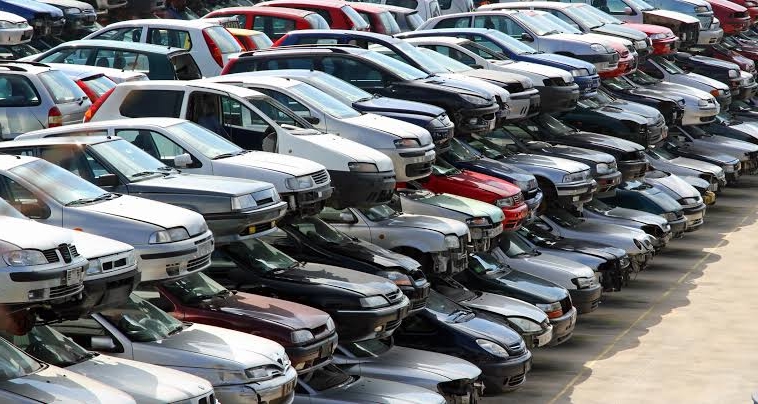
The Rise in dollar hit the tokunbo market hard resulting to an unfortunate consequence: their affordability is slipping out of the grasp of many individuals.
This unfortunate predicament can be attributed to the combination of inflation and foreign exchange crises.
This crises has led to a surge in the prices of foreign-used vehicles, as the rise in dollar rate to naira continues.
A Lagos resident, who wishes to remain anonymous, recently shared his personal experience.
He sold his 2007 Toyota Corolla in the Nigerian used car market for a substantial sum of N3.5 million.
The man had initially purchase the vehicle as a foreign-used car, commonly called ‘Tokunbo’, for as low as N2.5 million.
This significant increase in value over a span of four years serves as a testament to the current state of the used car market in Nigeria.
“Cars are now very expensive, and Nigerians are not putting a lot of money into buying foreign-used cars, which is why the majority are now going for Nigerian used cars, which are also very expensive.
I bought my Toyota Corolla as a foreign used car in 2020 and I sold it for N3.5 million four years after, which is unbelievable,” he said.
According to his statement, the act of purchasing an automobile has evolved into a financial investment.
He asserts that individuals need only to diligently maintain their vehicles to ensure that they remain in optimal condition for future resale.
The ongoing devaluation of the naira, coupled with a severe scarcity of foreign exchange, has resulted in a significant increase in the cost of importing cars into the country.
Prior to the liberalisation of the foreign exchange market in June of last year, the naira was valued at approximately 460 per dollar.
However, on Tuesday, it reached an unprecedented high of 1,482 per dollar.
“Nigerians are now selling their used cars years after using them for prices higher than the original purchase price.
This is largely due to the skyrocketing global inflation and scarcity of foreign exchange as well as the high exchange rate of naira to dollar resulting in the FX crisis”. Mr. Godswill Odoin said.
He continues by saying, “Then, with a little above N1million or N2million, one will get quality foreign-used cars of choice.
But today, I sold my 2004 Toyota Camry for N2.6 million, after using it for over seven years — a car that I bought for N1.550 million in 2016”.
A significant number of individuals in Nigeria are currently retaining their older vehicles due to financial constraints.
This phenomenon can be attributed to the adverse impact of the COVID-19 outbreak on the global economy.
BusinessDay interviewed an Auto-mechanic Mr. Kazeem Suraji who said;
“I advise my clients to pay serious attention to their cars these days by ensuring that they are well serviced.
Broken parts should be replaced in due time to avoid serious impact on the vehicle because that is the only way for them to keep their old or ageing cars in good condition”.
The crisis in the auto industry has been attributed to several factors by Ajibola Adedoyin, the National President of the Association of Motor Dealers of Nigeria.
Adedoyin points to the depreciation of the naira and volatility in the FX market as key contributors to the current situation.
Additionally, he highlights the impact of high import duties, the Vehicle Identification Number valuation policy of the Nigeria Customs Service, rising poverty levels, and the weakened purchasing power of consumers.
As a result of these challenges, many car dealers have made the decision to abandon the vehicle dealership business.



Five Die as Truck, Car Collide on Badagry Expressway

Two Killed as Trucks Collide, Burst Into Flames on Anambra Road

Stakeholders Raise Alarm Over Safety Gaps in Nigeria’s CNG and Electric Vehicle Transition

Female Driver Dies in Tragic Road Crash at Mongoro, Ile-Zik Area of Lagos

Physically Challenged Beggar Killed in Multi-Vehicle Crash on Lagos-Ibadan Expressway

Court Bars FRSC Officials From State Roads

24 Pupils Killed in Tragic Bus Crash During School Excursion in Uganda

Tyre Blowouts on Heavy Trucks

BYD Seal EV: Can It Challenge Traditional Sedans?

Colorado to Strengthen Driver Education Requirements

Slow Down: Man got his Family Killed by neglecting road signs

Which Bridge is the Tallest in the World?
Impatient Driving Cause Road Accident
How Roads are Constructed on the Mountain

Texas, USA suffers heavy flooding