
Articles
Why do Vehicles Somersault during Accidents?

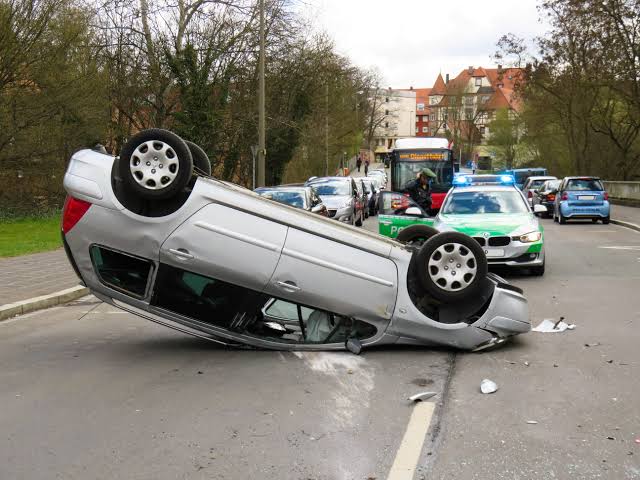
Vehicle accidents are unfortunate events that can lead to severe injuries, fatalities, and significant property damage.
One particularly dramatic and dangerous type of accident is when a vehicle somersaults or flips end-over-end.
Understanding the dynamics behind why vehicles somersault during accidents involves examining factors such as speed, vehicle design, road conditions, and the nature of the collision.
This article delves into these aspects to shed light on the mechanics of vehicle somersaults.
Speed and Kinetic Energy
Speed plays a crucial role in the dynamics of vehicle accidents.
When a vehicle is moving at high speed, it possesses a significant amount of kinetic energy.
In the event of a sudden stop or collision, this kinetic energy needs to be dissipated.
If the vehicle hits an obstacle or another vehicle, the sudden deceleration can cause a dramatic transfer of forces.
Depending on the angle and point of impact, these forces can lift the vehicle off the ground, leading to a somersault.
The higher the speed, the greater the kinetic energy and the more violent the potential flip.
For example, if a car traveling at high speed strikes a stationary object with its front end, the abrupt halt can create a forward rotational momentum.
This rotational force, combined with the vehicle’s inertia, can propel it into a somersault.
Vehicle Design and Center of Gravity
The design of a vehicle significantly impacts its stability and susceptibility to flipping.
Two critical factors in vehicle design are the center of gravity and the overall geometry of the vehicle.
Center of Gravity
A vehicle’s center of gravity (COG) is the point where its weight is evenly distributed in all directions.
Vehicles with a higher COG, such as SUVs and trucks, are more prone to flipping compared to sedans and sports cars, which have a lower COG.
This is because a higher COG increases the likelihood of the vehicle tipping over when subjected to lateral forces or sudden maneuvers.
Vehicle Geometry
The design elements such as wheelbase, track width, and suspension also play a role.
A shorter wheelbase can make a vehicle more prone to flipping because it reduces the longitudinal stability.
Similarly, a narrow track width (the distance between the left and right wheels) can decrease lateral stability, making the vehicle more susceptible to tipping during sharp turns or collisions.
Road Conditions and Obstacles
The condition of the road and the presence of obstacles are critical in the dynamics of vehicle somersaults.
Poor road conditions, such as potholes, uneven surfaces, or loose gravel, can destabilize a vehicle, leading to loss of control and potential flips.
Obstacles like curbs, barriers, or debris can also contribute to somersaults.
When a vehicle strikes a curb or a barrier at high speed, the wheels can be abruptly halted or forced upward.
This sudden change in motion can lift one side of the vehicle, causing it to roll over. Additionally, hitting an obstacle with one side of the vehicle can create a rotational force that initiates a somersault.
Collision Dynamics
The nature of the collision, including the angle and point of impact, plays a significant role in whether a vehicle somersaults.
Head-On Collisions
In head-on collisions, the sudden deceleration can create a forward rotational force.
If the vehicle’s front end is forced downward while the rear end is still moving forward, the vehicle can pivot around its front axle, leading to a somersault.
Side-Impact Collisions:
Side-impact collisions, particularly at high speeds, can impart a significant amount of rotational energy to the vehicle.
If the impact occurs near the vehicle’s center of gravity, it can create a torque that lifts the vehicle off the ground and initiates a flip.
Rear-End Collisions:
In rear-end collisions, especially involving larger vehicles striking smaller ones, the smaller vehicle can be propelled forward and upward.
This sudden acceleration combined with the force of the impact can cause the vehicle to somersault.
Human Factors
Human factors, such as driver behavior and response time, also contribute to the likelihood of vehicle somersaults.
Sudden evasive maneuvers, overcorrection, or panic braking can destabilize a vehicle and lead to flipping.
For example, a driver swerving sharply to avoid an obstacle at high speed can inadvertently cause the vehicle to lose traction and tip over.
Safety Measures and Prevention
Understanding the dynamics of vehicle somersaults is crucial for developing safety measures to prevent them.
Several strategies can be employed to reduce the risk of such accidents:
Vehicle Design Improvements:
Manufacturers can design vehicles with a lower center of gravity and wider track widths to enhance stability.
Advanced suspension systems that adjust to driving conditions can also help maintain stability.
Driver Assistance Systems:
Modern vehicles are equipped with advanced driver assistance systems (ADAS) such as electronic stability control (ESC), anti-lock braking systems (ABS), and traction control.
These systems help maintain vehicle control and prevent scenarios that could lead to flipping.
Road Infrastructure:
Improving road conditions by regularly maintaining and repairing surfaces can reduce the risk of accidents caused by poor road conditions.
Additionally, designing roads with proper barriers and guardrails can prevent vehicles from hitting obstacles that could cause somersaults.
Driver Education:
Educating drivers on the risks of high-speed driving, the importance of maintaining safe following distances, and the proper techniques for emergency maneuvers can reduce the likelihood of accidents that result in somersaults.
In conclusion, vehicle somersaults during accidents are the result of a complex interplay of factors including speed, vehicle design, road conditions, collision dynamics, and human factors.
By understanding these elements, we can develop better safety measures and technologies to prevent such accidents and improve overall road safety.
The continued advancement of vehicle design, driver assistance systems, and road infrastructure, combined with driver education, will play a pivotal role in reducing the occurrence of these dramatic and dangerous accidents.

Two Separate Highway Crashes Leave One Dead, Several Injured in Katsina

Victor Osimhen Reportedly Buys ₦1.4 Billion Lamborghini Revuelto Supercar

Truck Crash Kills Three After Collision With Parked Trailer in Kano

3 Killed, 6 Injured in Multiple-Vehicle Crash on Lagos–Abeokuta Expressway

Multi-Vehicle Crash Causes Fire and Gridlock on Admiralty Way, Lagos
Two Killed in Multi-Vehicle Crash Involving Truck, Bus and Motorcycle
Seven Killed, Eight Injured in Pakistan Makran Coastal Highway Crash
1 Killed as Speeding Bike Loses Control in Trichy

Kenya Report Reveals Heavy Cost of Road Traffic Injuries on Healthcare System

Serious Two‑Vehicle Crash in South Burnett, Australia
Serious Two‑Vehicle Crash in South Burnett, Australia
Seven Killed, Eight Injured in Pakistan Makran Coastal Highway Crash
Kenya Report Reveals Heavy Cost of Road Traffic Injuries on Healthcare System
Multi-Vehicle Crash Causes Fire and Gridlock on Admiralty Way, Lagos
Victor Osimhen Reportedly Buys ₦1.4 Billion Lamborghini Revuelto Supercar
1 Killed as Speeding Bike Loses Control in Trichy
3 Killed, 6 Injured in Multiple-Vehicle Crash on Lagos–Abeokuta Expressway
Two Killed in Multi-Vehicle Crash Involving Truck, Bus and Motorcycle
Truck Crash Kills Three After Collision With Parked Trailer in Kano
Two Separate Highway Crashes Leave One Dead, Several Injured in Katsina

Slow Down: Man got his Family Killed by neglecting road signs

Which Bridge is the Tallest in the World?
Impatient Driving Cause Road Accident
How Roads are Constructed on the Mountain

Texas, USA suffers heavy flooding